

Understanding how muscular tension reflects emotional defenses is essential for clinicians and students working with the body in psychotherapy, and for clients who want practical tools to reduce suffering and change entrenched relationship patterns. Muscular tension is not merely a biomechanical problem: it is a living record of adaptive strategies—defenses—that protect the nervous system, organize identity, and shape interpersonal behavior. This article synthesizes Wilhelm Reich’s character analysis, Alexander Lowen’s bioenergetic perspectives, and contemporary somatic research to explain why tension forms, how to read it accurately, and which therapeutic strategies lead to durable change.
Transition: Before we map patterns and techniques, we need an integrative foundation. The next section provides the physiological and theoretical scaffolding that explains how the body converts emotional conflict into stable muscular patterns.
Fundamentals: how muscular tension reflects emotional defenses
Mechanics of armoring: muscle, fascia, and autonomic regulation
Muscular tension is produced and maintained by the interaction of skeletal muscle, connective tissue (fascia), and the autonomic nervous system (ANS). When an emotion or threat is felt, motor pathways activate muscle groups to prepare for action—fight, flight, freeze, or social engagement. If action is not taken or is chronically inhibited, the motor system, through repeated neural firing and metabolic adjustments, establishes a default state: increased resting tone, reduced elasticity, and altered breathing mechanics. Over time fascia tightens and movement segments become segmented, producing what Reich termed muscular armor.
Armoring is not random. Different emotions and relational dangers recruit predictable muscular responses: fear frequently shows as pelvic floor and lower back tension; shame and sadness compress the chest and diaphragm; anger tightens the jaw, neck, and shoulders. These patterns reflect the redundancy of motor programs and the economy of protective strategies the nervous system prefers.
Psychological function: defenses encoded in muscle
From a psychodynamic and somatic perspective, muscular tension serves three primary psychological functions: protection, containment, and expression control.
- Protection: Tension prepares the body to block perceived threat or boundary violation—literal or symbolic.
- Containment: Tightening around the chest, abdomen, or pelvis limits affective discharge so overwhelming feelings don’t overwhelm cognition or social function.
- Expression control: Muscle patterns regulate communication—tone of voice, facial expression, and gesture—to defend against rejection or punishment.
These functions explain why defenses persist: they worked adaptively in developmental contexts, even if they later create pain, intimacy problems, or emotional constriction.
Reich and Lowen: concepts that connect body and character
Wilhelm Reich proposed that early relational and traumatic experiences become organized into *character defenses*—patterns of belief, affect, and posture. He described character armoring as chronic muscular contraction that mirrors psychic defense. Alexander Lowen extended Reich’s work into therapeutic practice called bioenergetic analysis, designing interventions that directly mobilize these muscular contractions to restore emotional flow. reichian character structures guide both systems: treat the body as a psychophysiological whole, and assume that changing somatic patterns alters emotional patterns.
Contemporary neuroscience supports these principles: sensorimotor integration, interoception, and plasticity in cortical and subcortical networks mean that somatic interventions can reorganize both physiology and affective habits. Polyvagal theory clarifies how vagal tone modulates social engagement versus defensive postures, making muscular tension a visible index of underlying autonomic states.
Transition: With the basics in place, the next section translates abstract theory into practical maps: common character structures and the muscular signatures they display.
Mapping muscular patterns to character structures and defenses
How to read a pattern: posture, movement quality, and affective tone
Reading muscular patterns requires attention to static posture and dynamic movement: where the chest rests, how the pelvis is oriented, jaw tension, breath depth, and habitual micro-expressions. Also notice timing—latency between stimulus and emotional response—and modulation—ability to shift intensity. These dimensions reveal which defenses are dominant: inhibition (slow, restricted movement), enactment (sudden booming expression), or dissociation (flattened affect, reduced interoception).
Schizoid tendencies: detachment, fragmentation, and segmental tension
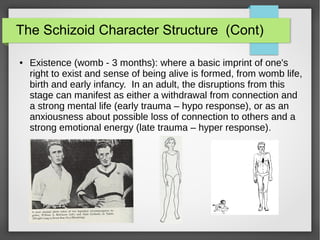
Characterized by withdrawal and cognitive distancing, the schizoid pattern often displays segmental armor: neck stiffness, shoulder rounding, and a flat upper chest with reduced breath amplitude. Movement quality is guarded; transitions between segments (e.g., thorax to pelvis) are disconnected. Defenses include intellectualization and dissociation. Clinically, these clients may report numbness, chronic cervical pain, or headaches. Therapeutic aim: restore intersegmental integration and gentle re-engagement of affective sensation through paced breath, tactile orientation, and slow, supported movement.
Oral/masochistic pattern: enmeshment, collapse, and visceral holding
Oral or masochistic character structures often manifest as a collapsing posture—rounded shoulders, forward head, and a softened or sunken chest—combined with tightness in the diaphragm and pelvic floor. These tensions serve to hold grief and dependency while protecting against engulfment through passive compliance. Clinically this shows as chronic digestive complaints, low energy, and difficulty asserting needs. Interventions emphasize upright grounding, precise pelvic somatic work, and exercises that strengthen assertive breath and vocal presence.
Psychopathic or narcissistic armor: hypermobilized exterior and hidden rigidity
What appears as energetic or expansive posture can hide localized rigidity: a fixed jaw, tight temporalis muscles, and stiff shoulders that maintain dominance and suppress vulnerability. The defense is exteriorization—projecting strength to avoid shame. Relationship patterns include entitlement and limited empathy. Therapy requires carefully negotiated boundary work: asserting empathic confrontation while creating somatic experiences that safely address the vulnerable underlying tissues (e.g., submandibular release and supported chest vulnerability exercises).
Masochistic/sadomasochistic variants: collapsing tension with explosive release
These patterns combine low-tone collapse (pelvis, abdomen) with episodic constrictions (thoracic armor) that periodically discharge in pain or rage. Defenses oscillate between submission and explosive rebellion. The muscular presentation can include pelvic floor spasms, sacroiliac stiffness, and tightness across the upper trapezius. Treatment integrates graduated activation—work that raises baseline tone safely—and controlled expressive modalities (voice, striking cushions) to renegotiate consent to affective discharge.
Rigid/compulsive character: chronic contraction and inhibited respiration
Rigid types show a solid, constricted torso: horizontal rib cage with limited diaphragmatic movement, tight abdominal wall, and a jaw set that rarely relaxes. Defense is control—suppressing spontaneity to manage perceived chaos. Pain syndromes often include tension-type headaches, thoracic outlet restrictions, and low back stiffness. Interventions focus on increasing rib mobility, softening the jaw, and reintroducing playful, non-goal-oriented movement to loosen the tyranny of perfectionism.
How chronic pain and postural syndromes are defensive designs
Common musculoskeletal complaints—chronic neck pain, tension headaches, irritable bowel, pelvic pain—often persist because they serve a defensive function: pain localizes attention and maintains a predictable state, reducing exposure to more disorganizing emotions. Reframing pain as an active defense helps clinicians avoid purely biomechanical models and guides integrative interventions that target both tissue and affective meaning.
Transition: Identifying patterns is only useful when assessed reliably and ethically. The following section details observational and manual assessment strategies that respect boundaries and reduce iatrogenic harm.
Assessment: how to read muscular tension in therapy
Observation: posture, gait, and micro-expression
Start with non-intrusive observation. Look at the client arriving: gait, weight distribution, head carriage, facial expression, and how they sit—do they take the chair fully, or perch? Observe breath rhythm and voice quality. These external cues are high-yield indicators of internal organizational tendencies. Keep notes on baseline state vs. moments of affective arousal during the session to map reactivity and recovery patterns.
Palpation and touch: what to feel and how to proceed
Touch reveals tone, temperature differences, fascial adherence, and muscular guarding. Use a graduated approach: begin with non-invasive contact (hand on shoulder), asking permission and explaining purpose. Palpation should assess resting tone, trigger points, and asymmetries. Document findings and avoid aggressive manipulations in the first sessions. Use touch to orient the client to sensation, not to force release. Always maintain trauma-informed consent: explain what may happen and offer ways to stop at any moment.
Breath and voice as diagnostic windows
Breath is the first diagnostic tool. Note depth (thoracic vs diaphragmatic), rhythm (regular vs arrhythmic), and audible blocking (high-pitched or silenced exhalation). Voice reveals constriction—chest-bound voices are common in depressive holding; thin, fast voices suggest anxiety. Asking the client to sigh, voice a vowel, or hum will reveal segments of restriction quickly and safely when framed as exploration rather than forced release.
Body mapping and symptom narrative
Invite clients to draw or describe where they feel tension and which emotions associate with it. Body maps externalize subjective experience and create a shared language. Combine this with standardized tools when appropriate: pain scales, the Body Awareness Questionnaire, or affect regulation indexes. The goal is triangulation: subjective report + observation + palpation to form a working hypothesis.
Transition: Assessment suggests interventions. The following section outlines techniques that reliably change muscle tone and reorganize defenses while maintaining safety and integration.
Interventions: techniques to release armor and reorganize defenses
Bioenergetic exercises and grounding practices
Bioenergetic exercises aim to increase somatic awareness, restore breath, and discharge chronic tone. Basic exercises include grounding (standing with knees slightly bent, sinking weight into the feet while breathing into the soles), chest expansions (inhaling into the ribs with hands on the lower ribs), and shaking to release limb tension. The clinician’s role is to titrate intensity, coach alignment, and hold affective containment so clients can tolerate release without flooding.
Simple client practice for grounding (can be done in session): Stand barefoot, feet hip-width, knees soft. Inhale slowly for a count that fills the belly; exhale with gentle sighing sound. Keep shoulders relaxed. Repeat 8–12 times. Observe shifts in warmth and mobility.
Breath work and vocalization
Re-establishing diaphragmatic breathing unlocks chest and pelvic restrictions. Techniques: supported diaphragmatic breathing (hands on lower ribs to guide movement), extended exhale practices to down-regulate hyperarousal, and safe vocalization (sustained vowels, therapeutic shouting into a pillow in tightly controlled sessions) to break held constriction in the throat and chest.
Movement and expressive approaches
Movement provides sensorimotor feedback and re-patterns habitual defenses. Use slow, intentional mobilization first: spinal articulation, pelvic tilts, and shoulder rolls, then integrate expressive modalities—dance, striking a cushion, or primal sound—when the nervous system is resourced. Sensorimotor Psychotherapy and Somatic Experiencing provide protocols for titrated activation and tracking of sensation, which are essential when trauma history exists.
Hands-on bodywork and structural techniques
Manual therapies—myofascial release, neuromuscular therapy—can soften chronic contractions and allow new movement patterns. Pair manual work with verbal tracking and resourcing so release becomes meaningful rather than merely relieving. Avoid deep tissue work without somatic tracking; uncontained release can trigger dissociation or re-experiencing.
Integrating talk therapy: narrative, meaning, and relational re-patterning
Somatic change must be integrated into the client’s psychological narrative. After a somatic release, use short reflective questions: “What changed when the breath opened?” or “Where did that emotion move you?” Linking sensation to story prevents relapse: the body learns both the new pattern and its psychological context. Also use relational enactments in session to practice new responses—assertion training, boundary signaling—with somatic cues present.
Safety, titration, and trauma-informed parameters
Key principles: (1) Resourcing before activation—ensure the client has internal or external anchors. (2) Titration—limit intensity so the client stays within window of tolerance. (3) Containment—therapist’s steady presence reduces shame and panic. (4) Consent—explicit consent for touch or intense techniques. For clients with PTSD, phase-based treatment that starts with stabilization is essential.
Transition: Measuring change requires both subjective and objective markers. The next section explains expected outcomes and what research shows about somatic interventions.
Outcomes: what changes when muscular tension is worked with intentionally
Emotional regulation and reduced reactivity
When chronic tension relaxes, clients often report increased affect tolerance: they can feel sadness or anger without being overwhelmed. This correlates with improved vagal tone and better parasympathetic engagement. Practically, clients pause less reactively in arguments and recover more quickly from triggers.
Improved relationships and increased intimacy
Muscular defenses shape interpersonal choreography—where people hold themselves influences how they ask for needs and respond to closeness. Loosening armor allows richer nonverbal signaling: softer eye contact, open chest, receptive gestures. This translates into clearer boundaries, more authentic expression, and improved sexual and emotional intimacy.
Reduction in somatic symptoms
Clients commonly experience decreases in headaches, neck and back pain, digestive complaints, and insomnia after structured somatic work. Some improvements occur rapidly (breath-related headaches), others slowly (pelvic pain with long-standing muscular guarding). Documenting symptom trends with weekly scales helps maintain momentum and plan phases of treatment.
Neurophysiological evidence and mechanisms
Research indicates somatic therapies modulate autonomic balance, decrease cortisol, and enhance functional connectivity across emotion regulation networks. Studies on body-oriented therapies report improvements in PTSD, chronic pain, and mood disorders, supporting the clinical observations that changing muscle tone alters affective organization. While mechanisms are still being mapped, changes in interoceptive accuracy and normalization of stress response patterns are consistent findings.
Transition: Even skilled clinicians face resistance and ethical dilemmas. The next section addresses common challenges and how to manage them responsibly.
Common challenges, resistance, and ethical considerations
Resistance and enactments: interpreting somatic pushback
Resistance often appears as somatic defenses—tightening, fidgeting, or sudden dissociation—when a therapist moves too quickly. Treat these as data, not failure. Slow the pace, re-resource, and invite curiosity: “I notice your shoulders tensing when we talk about that—what is that like for you?” This maintains alliance and prevents retraumatization.
Cultural and gendered expressions of tension
Body language and tension expressions are culturally mediated. Some communities normalize stoicism; others encourage expressive release. Gender shapes where emotion is held—men may hold more in jaw and chest because socialization penalizes vulnerability. Attend to cultural scripts and avoid pathologizing differences; ask clients how their body holding relates to identity and context.
Scope of practice, safety, and interdisciplinary collaboration
Somatic work intersects with physical therapy, osteopathy, and medicine. If pain has red flags (neurological deficit, systemic disease), refer for medical evaluation. Collaborate with other professionals when structural issues or medication management are involved. Maintain clear documentation, informed consent, and boundaries around touch and scope.
Transition: To close, synthesize actionable steps clinicians and clients can use immediately to begin reshaping defensive tension.
Concise summary and actionable next steps
Muscular tension is an accessible and reliable indicator of emotional defenses: it records early adaptations, sustains identity, and constrains relationships. Treating tension directly—through observation, breath, movement, and integrative talk—reorganizes both body and mind. Here are practical next steps you can apply now.
- For clients: Start a daily 5-minute grounding practice: feet on floor, slow diaphragmatic breaths, and a gentle body scan from feet to head. Note one emotion that shifts during the practice.
- For therapists: Add a somatic assessment to intake: observe posture, ask for a body map, and request a baseline breath sample (three normal breaths). Use this data to form hypotheses about defensive patterns.
- For educators: Teach students one bioenergetic exercise and one containment strategy per case: grounding with breath and a brief resourcing anchor (a safe memory or object) to use before activation.
- For all: Adopt trauma-informed parameters: always get explicit consent for touch, begin with resourcing, titrate intensity, and integrate somatic shifts into narrative meaning.
Applying these steps with curiosity and discipline shifts muscular tension from being an intractable symptom to a therapeutic entry point. By reading the body and intervening with respect for nervous system limits, clinicians and clients can transform defensive armor into embodied resilience.